Revision technique
How to Score Full Marks in Cambridge IGCSE Physics Paper 6
Avenlo Editorial · Published 15 September 2026 · 8 min read
To aim for full marks in Cambridge IGCSE Physics Paper 6, practise explaining experiments as carefully as you practise calculations. Read scales accurately, organise results clearly, construct graphs methodically and support conclusions with evidence. No checklist guarantees a perfect score, but a consistent checking routine gives you a practical way to identify and correct weaknesses.
What does Physics Paper 6 assess?
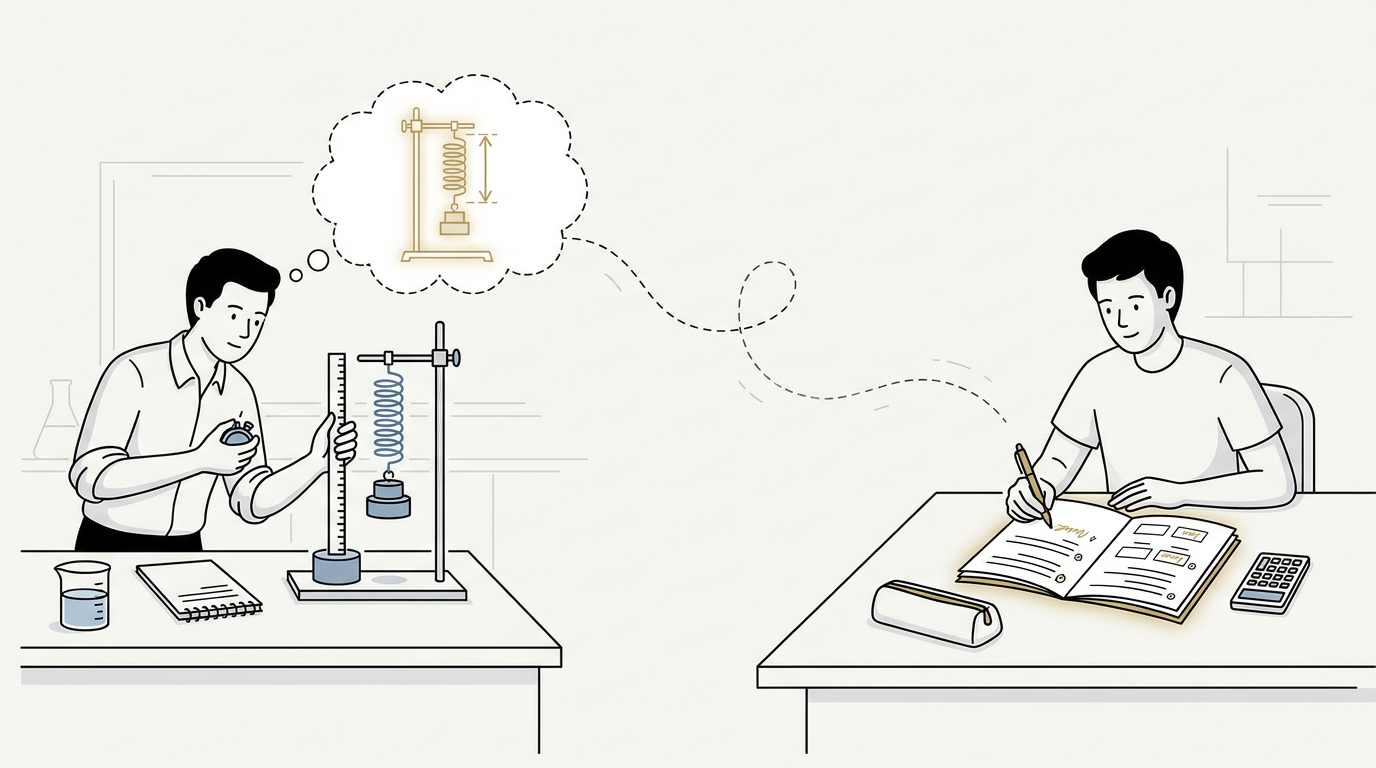
For the 2026–2028 Cambridge IGCSE Physics 0625 syllabus, Paper 6 is the Alternative to Practical: a one-hour paper worth 40 marks and 20% of the qualification. All items are compulsory. It assesses AO3, experimental skills and investigations, without requiring candidates to perform experiments during the test.
Cambridge describes Physics 0972 as the 9–1-graded version of 0625, otherwise following the same syllabus. The preparation approach below therefore applies to both. Check the syllabus for your examination year before selecting revision materials.
Alternative to Practical does not mean alternative to practical experience. Cambridge explicitly advises hands-on experimental preparation. In school laboratory lessons, ask yourself what you measured, why the method worked and what limited the result.
The examples below are original teaching examples, not past-paper extracts or quotations from mark schemes.
1. Turn each question into a short task list
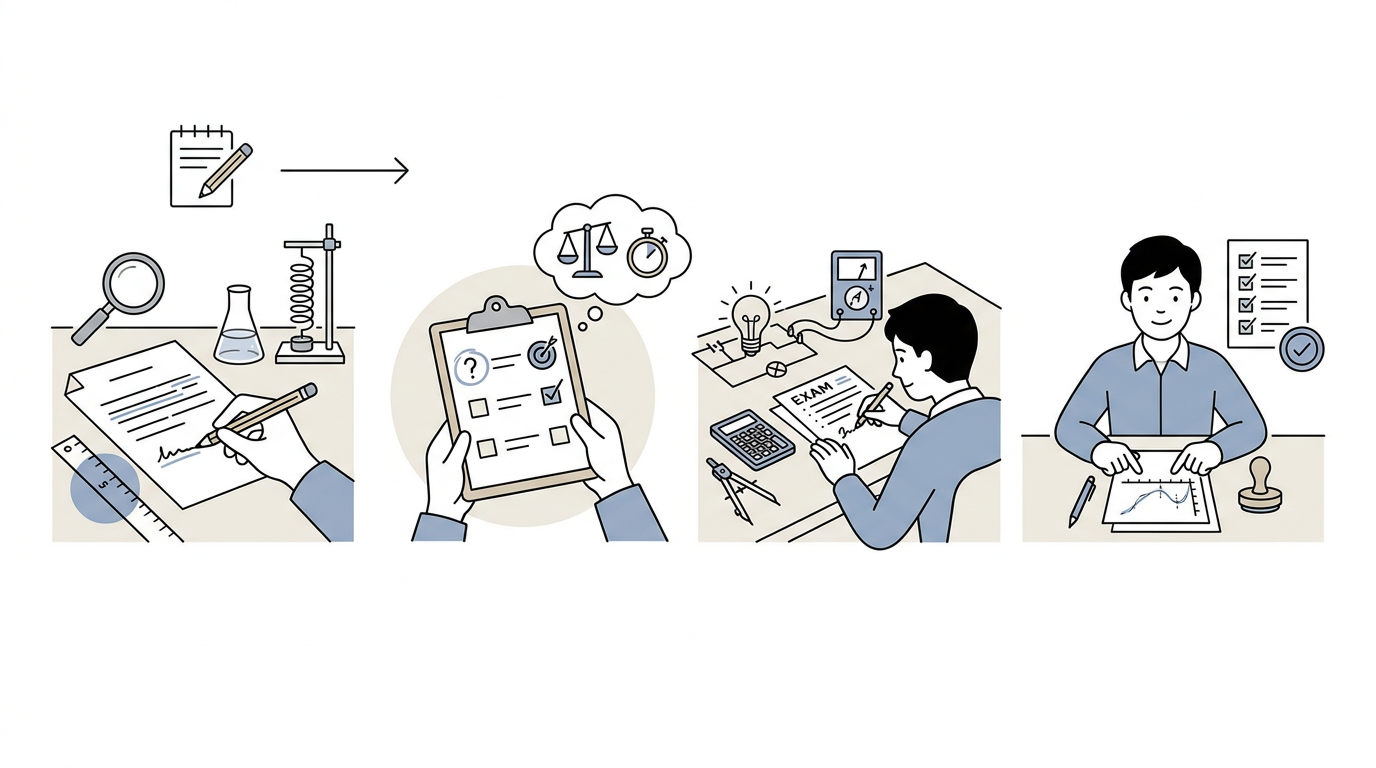
Before answering, identify exactly what you must produce. Try underlining the requested quantity, circling any unit and noting whether the question asks for a calculation, explanation, comparison or method.
For a multi-part instruction, make a mental checklist. If you must calculate two values and compare them, completing the arithmetic is not the end of the task.
Use this answering routine:
- Identify what is given.
- Identify what is requested.
- Complete the calculation, drawing or explanation.
- Check that your final response addresses the actual question.
Avoid writing everything you remember about the topic. Aim instead for an answer in which every sentence has a clear purpose.
2. Practise measurements and tables separately
Cambridge’s practical assessment includes reading instruments, recording measurements with appropriate precision and units, and correcting zero errors where required.
Use a scale-reading drill
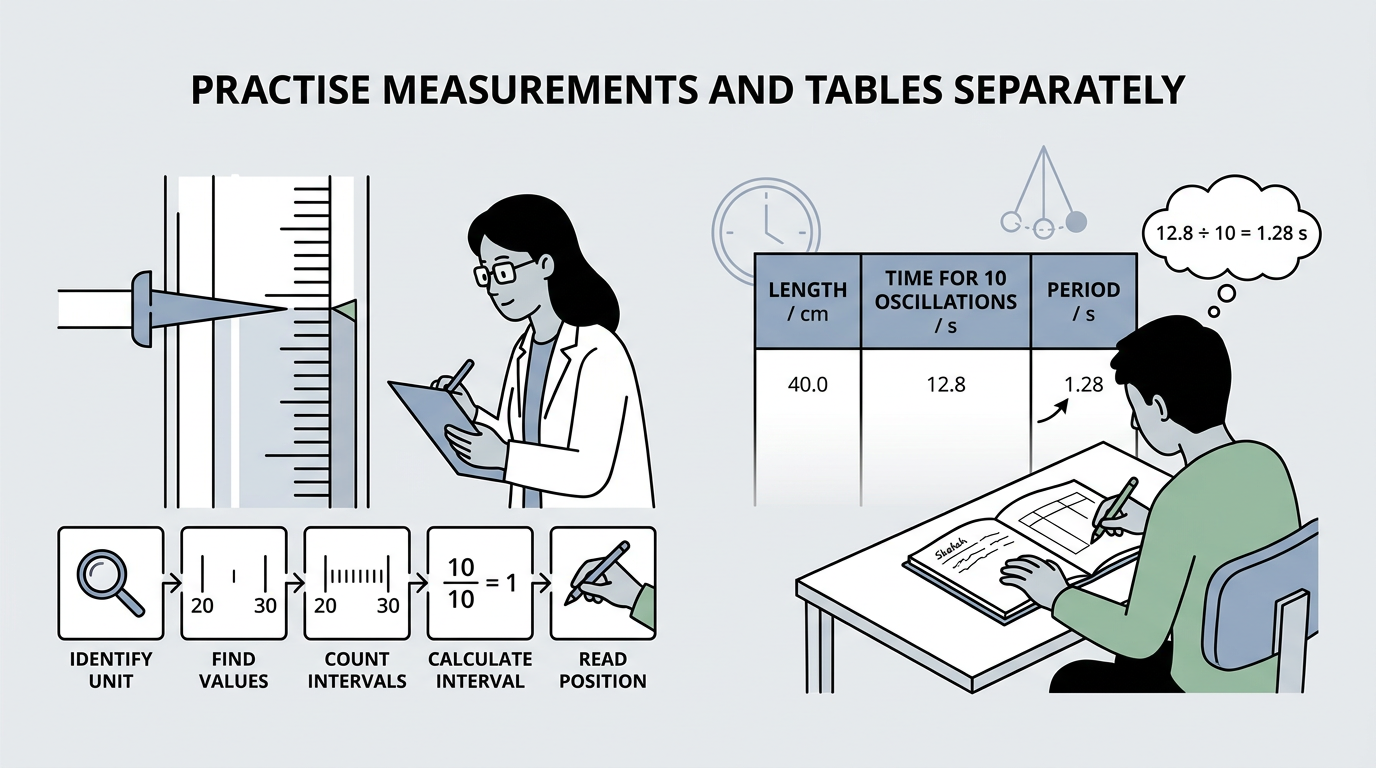
During revision, collect several instrument diagrams and work through each in the same order:
- Identify the unit.
- Find two labelled scale values.
- Count the intervals between them.
- Calculate the value of one interval.
- Read the indicated position.
For example, imagine a scale with ten equal intervals between 20 and 30. Each interval represents one unit. A pointer at the seventh interval after 20 indicates 27.
Write this reasoning beside a few practice diagrams before attempting to do it mentally. The aim is to replace guessing with a repeatable method.
Make table headings do the work
Try organising an invented pendulum investigation using headings such as:
| Length / cm | Time for 10 oscillations / s | Period / s |
|---|---|---|
| 40.0 | 12.8 | 1.28 |
In this example, the period is calculated as 12.8 ÷ 10 = 1.28 s. Check both the arithmetic and whether you have calculated the quantity named in the heading.
When reviewing your own tables, ask: could another student understand every column without reading my notes? If not, improve the headings before adding more results.
3. Show calculations so you can check them
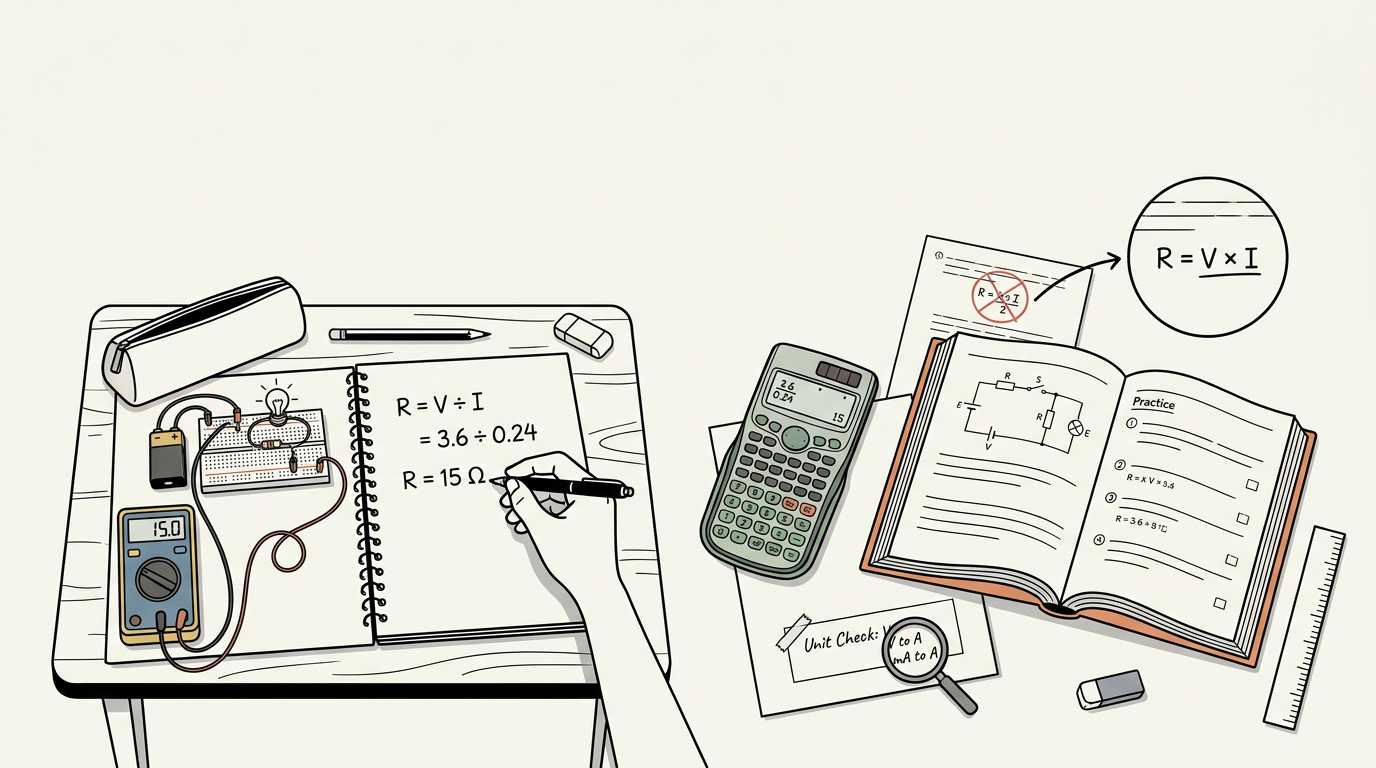
Adopt a three-line layout for practice calculations:
- Relationship or equation.
- Substitution of values.
- Answer with its unit.
For an invented resistance calculation:
R = V ÷ I
R = 3.6 ÷ 0.24
R = 15 Ω
Keep intermediate calculator values until the final step, and follow any precision instruction in the question. Make a separate check for unit conversions before substituting numbers.
A useful revision exercise is to take a previously incorrect calculation and identify the exact point of failure: selecting the equation, rearranging it, converting a unit, entering numbers or rounding. Practise that step rather than simply copying the correct answer.
4. Use a deliberate graph routine
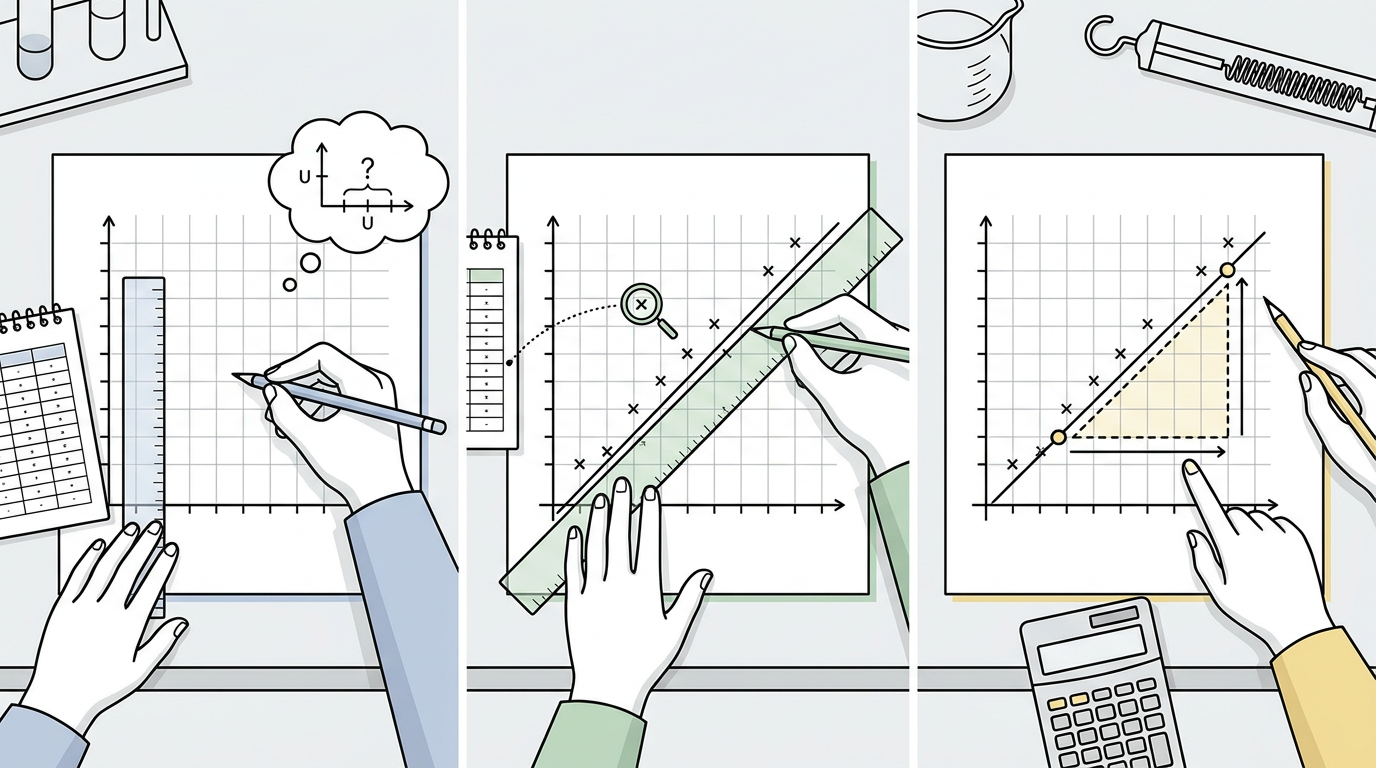
Graphical presentation, best-fit lines, interpretation and determining gradients or intercepts are included in Cambridge’s experimental-skills requirements.
Build the following routine into your graph practice, while always following the particular question’s instructions.
Before plotting
Write down the requested horizontal and vertical quantities. Add units, then test a possible scale against the smallest and largest values before committing to it.
For practice, favour straightforward scales that you can read without repeated arithmetic. Check that the data will occupy a useful portion of the grid.
After plotting
Recheck each plotted point against the table, one at a time. Then draw the requested line or curve. Do not automatically connect successive points or force a line through the origin: first consider the instruction and the data.
When finding a gradient
For a straight-line gradient exercise, choose two widely separated positions on your drawn line and show a clear triangle. Record their coordinates before calculating:
gradient = change in vertical quantity ÷ change in horizontal quantity
For example, using positions (2.0, 1.4) and (8.0, 4.4):
gradient = (4.4 − 1.4) ÷ (8.0 − 2.0) = 0.50
Attach units from the axes where appropriate. As a final check, ask whether the sign of your answer matches the line’s direction.
5. Write conclusions around evidence
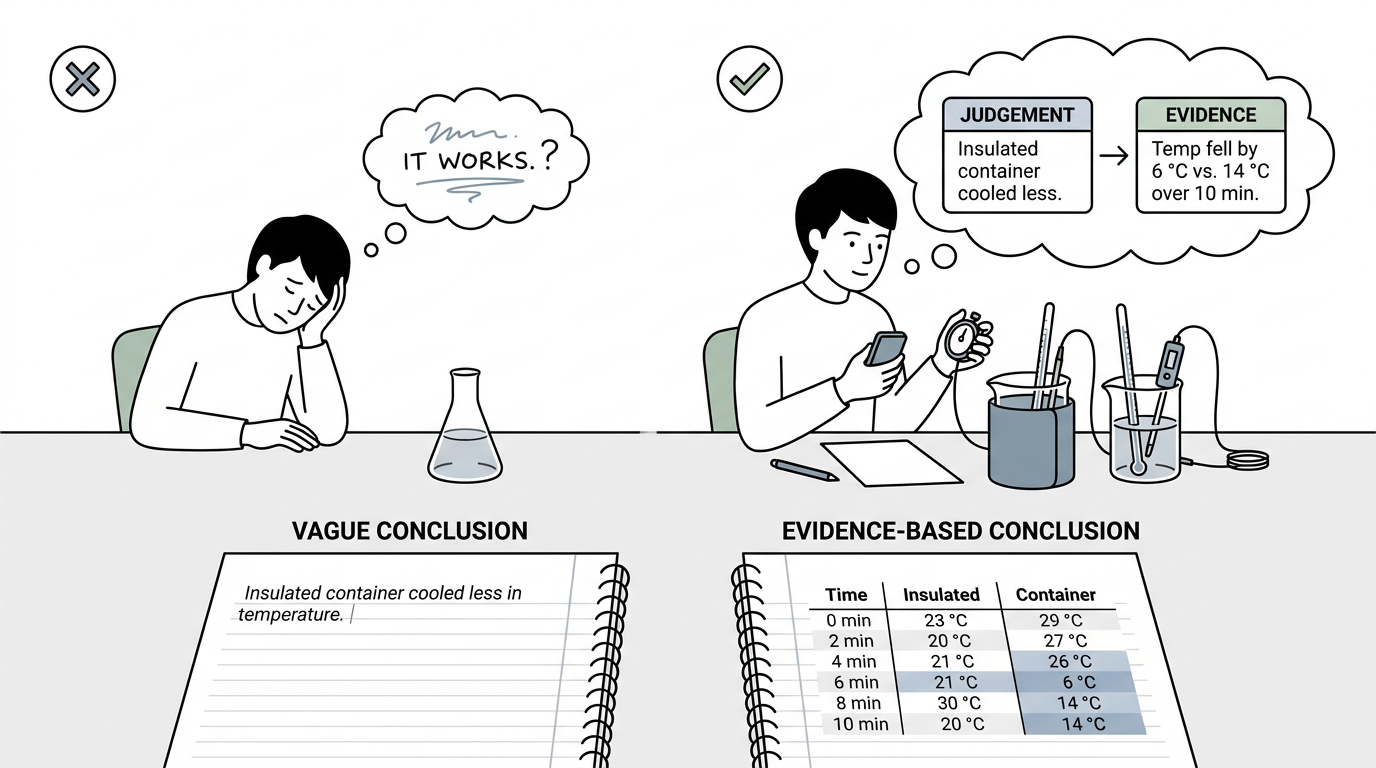
Cambridge expects conclusions justified by observations or data, rather than unsupported statements.
Practise a two-part conclusion:
- Judgement: answer the question being investigated.
- Evidence: identify the readings, calculation or graph feature supporting it.
Compare these invented responses:
Too vague: “The insulation works.”
More informative: “The insulated container cooled less over the same interval: its temperature fell by 6 °C, compared with 14 °C for the uninsulated container.”
Before finalising a comparison, check that you are comparing like with like. Have you used the same time interval, the same measured quantity and compatible units?
If a question supplies a numerical criterion, apply it explicitly. Do not replace an instructed comparison with a personal judgement that the values “look close”.
6. Make improvements specific to the experiment
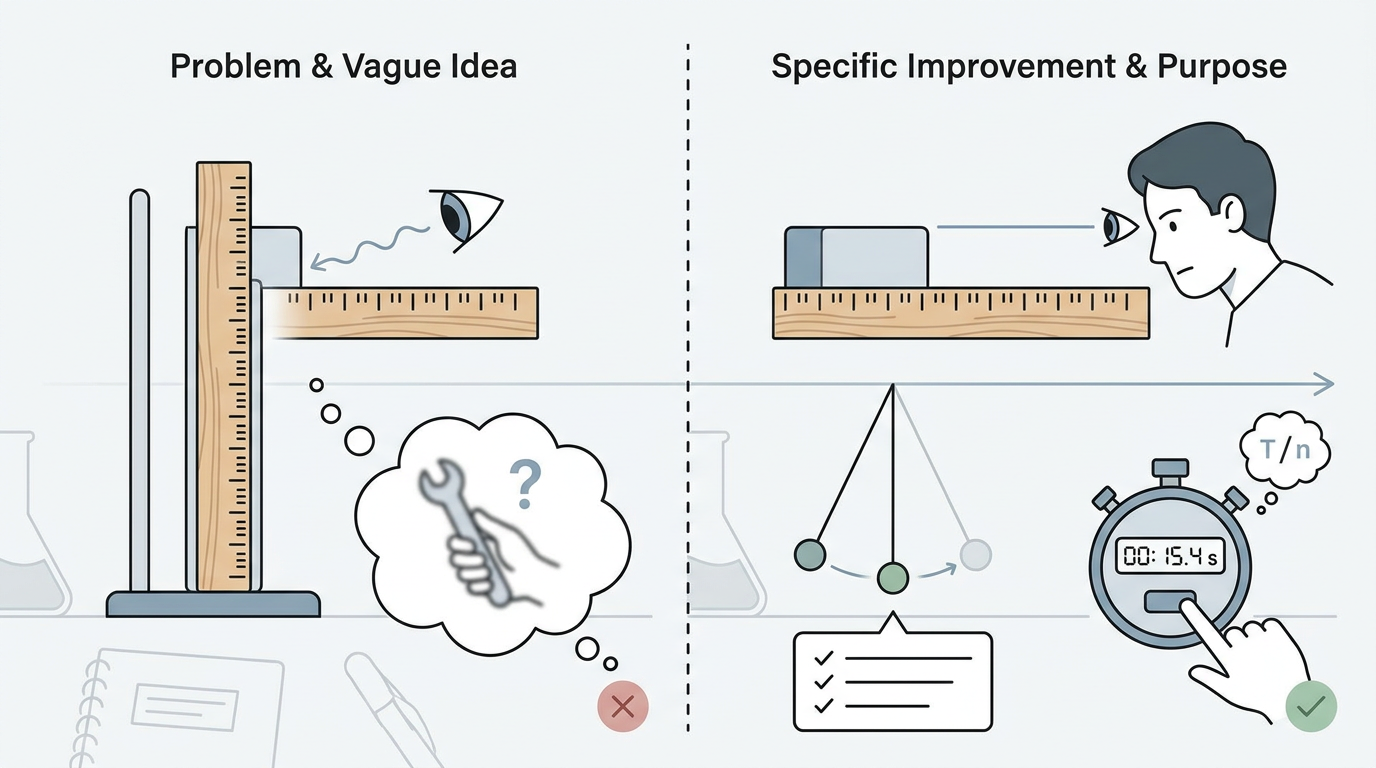
Planning, evaluating methods and suggesting improvements are part of the practical assessment.
Use the writing structure problem → change → purpose. Treat it as a prompt for reasoning, not a memorised answer.
For a practice ruler measurement, you might write:
For a practice timing investigation:
Before using either suggestion, check that the described problem actually exists in the apparatus or method shown. An improvement that is already built into the procedure adds little to your evaluation.
During revision, ban yourself from writing “be more careful” or “use better equipment” without explaining the action you mean. Name the instrument, adjustment or measurement procedure.
7. Plan an investigation another student could follow
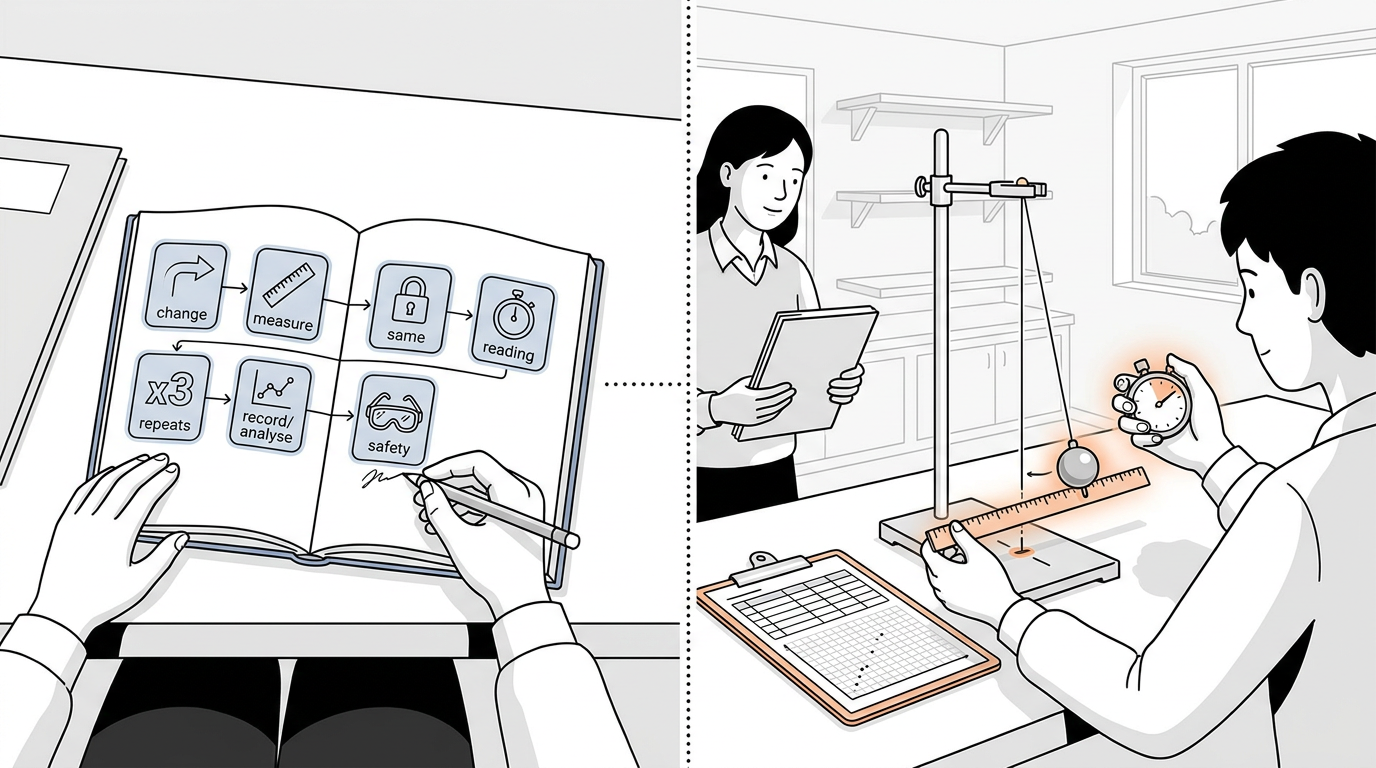
When practising planning questions, draft a compact procedure rather than a list of disconnected equipment names.
Use these prompts:
- What will I change?
- What will I measure?
- What must remain the same?
- How will I take each reading?
- What settings and repeats will I use?
- How will I record and analyse the results?
- What relevant safety precaution is needed?
Original practice example: pendulum length and period
Try developing this outline into a complete plan:
- Set up a pendulum securely under teacher supervision.
- Measure its length from the pivot to the centre of the bob.
- Release it from a small, consistent angle without pushing.
- Time ten complete oscillations using a fixed reference position.
- Repeat the timing and calculate a mean period.
- Repeat for several clearly specified lengths within the apparatus’s usable range.
- Keep the bob and release angle unchanged.
- Record length and mean period, then graph the results to examine the relationship.
These are practice choices, not universal requirements for every planning question. Adapt your answer to the supplied apparatus, aim and instructions.
Test your completed plan by giving it to a classmate: what would they still need to ask before starting? Add those missing details.
8. Revise through correction, not just completion
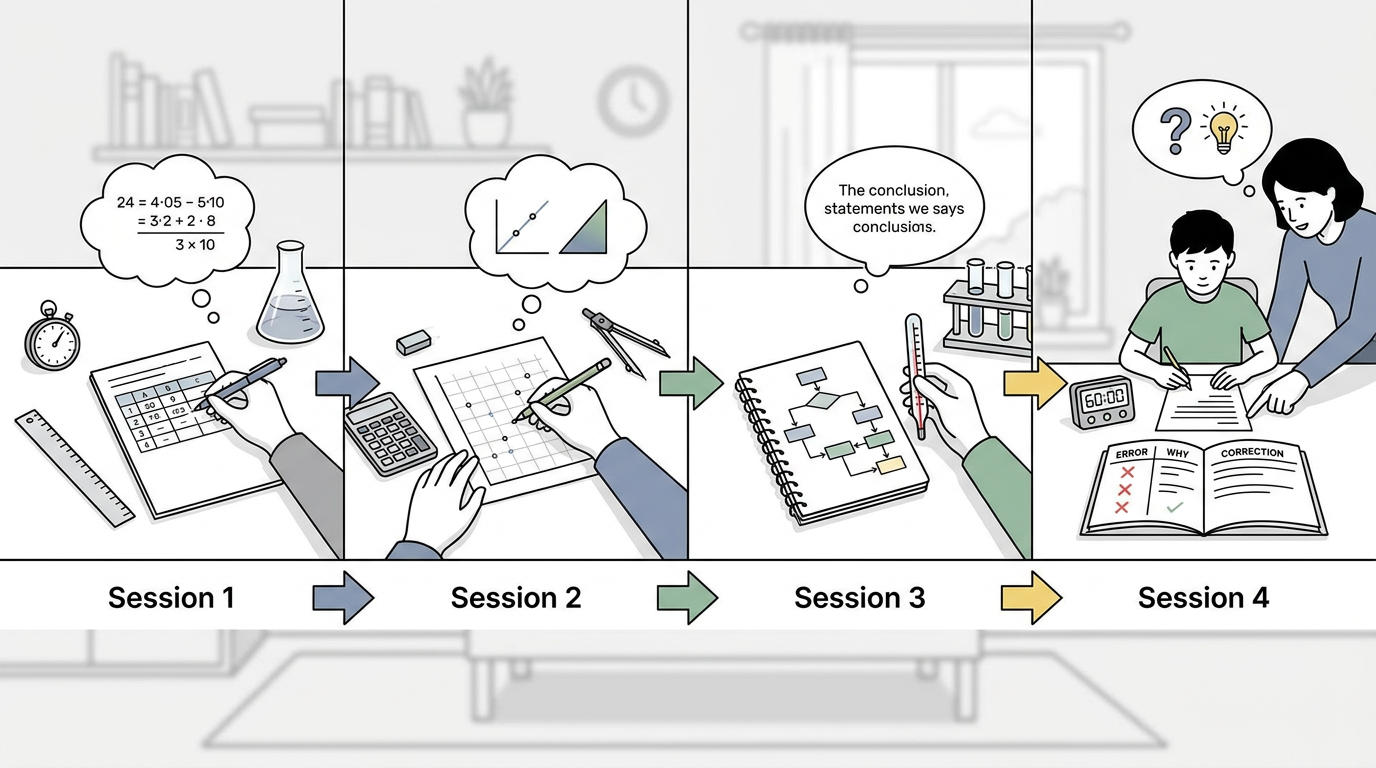
Try alternating focused skill sessions with whole-paper practice. For full timed attempts, use the verified one-hour duration, but treat any personal time split as a practice strategy rather than an official rule.
A suggested weekly cycle is:
- Session 1: instrument readings, tables and calculations.
- Session 2: graphs and gradients.
- Session 3: conclusions, improvements and planning.
- Session 4: a timed paper followed by careful review.
Use the matching official mark scheme when reviewing a past paper. Keep an error log with three columns: what went wrong, why it happened and what you will do differently.
For example, replace “graph mistake” with “misread the horizontal scale; check each plotted coordinate against the table”. Redo the affected question later without looking at the correction.
Parents can help by asking students to explain an experimental choice aloud. Questions such as “What would you keep constant?” and “Which result supports that conclusion?” keep the discussion focused on reasoning.
Summary

Aim for full marks by making your work easy to follow and easy to check. Practise measurements, calculations and graphs alongside experimental explanations. Support conclusions with evidence, make improvements specific and write plans someone else could carry out. After every practice attempt, identify one precise weakness and correct it before moving on.
Sources
- Cambridge IGCSE Physics 0625 syllabus for examination in 2026, 2027 and 2028 — Verifies Paper 6 duration, marks, weighting, compulsory items and AO3 assessment; identifies measurement, graphing, conclusion, planning and evaluation skills.
- Cambridge IGCSE (9-1) Physics (0972) — Confirms that 0972 is graded 9–1 but is otherwise the same as Cambridge IGCSE Physics 0625.
- My candidates are doing the Alternative to Practical paper, so what practical work do they need to do? — Explains that Alternative to Practical preparation should include hands-on experimental work.