Revision technique
How to Revise Effectively for CIE IGCSE Physics Paper 4
Avenlo Editorial · Published 15 September 2026 · 8 min read
The most effective way to revise for CIE IGCSE Physics Paper 4 is to combine active recall of physics principles with regular exam-question practice and careful correction of mistakes. Learn to select equations, explain physical processes and interpret unfamiliar situations—not just memorise notes. Use your current syllabus to check coverage, then build a revision routine around your weakest skills and topics.
What should Paper 4 revision focus on?
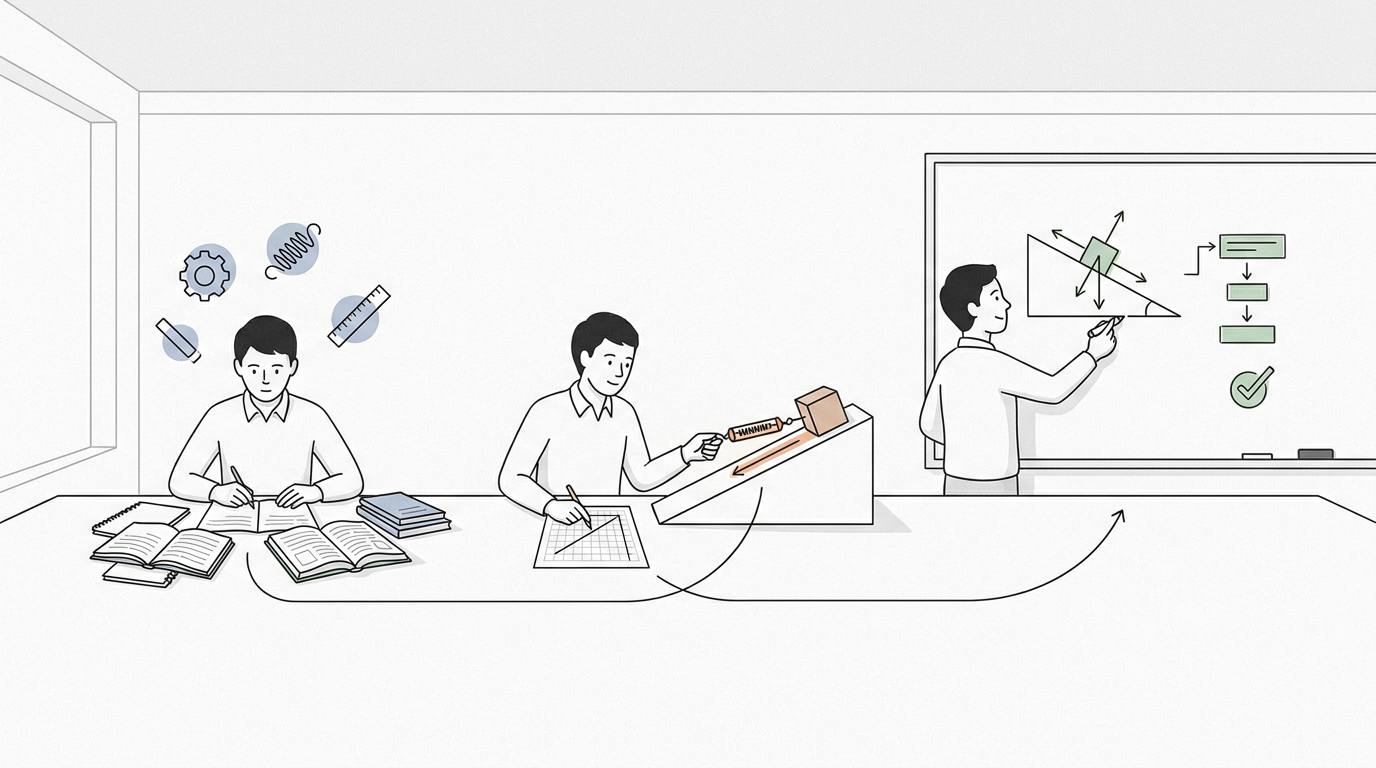
For Cambridge IGCSE Physics 0625 and 0972, Paper 4 is the Extended Theory component. Check the current Cambridge syllabus for your qualification and examination year to confirm the assessment details and required content.
Effective preparation needs three connected skills:
- Knowledge: recalling definitions, relationships, quantities and units.
- Application: using familiar physics in a situation you have not seen before.
- Communication: showing calculations and explaining ideas clearly enough for your reasoning to be assessed.
Knowing a definition is only the starting point. You should also be able to recognise when that idea applies, connect it to other principles and use information from a question to support your answer.
Although Paper 4 is a theory paper, do not ignore graphs, measurements or experimental contexts. These can provide situations in which you must apply theoretical understanding.
Start with a syllabus-based revision checklist
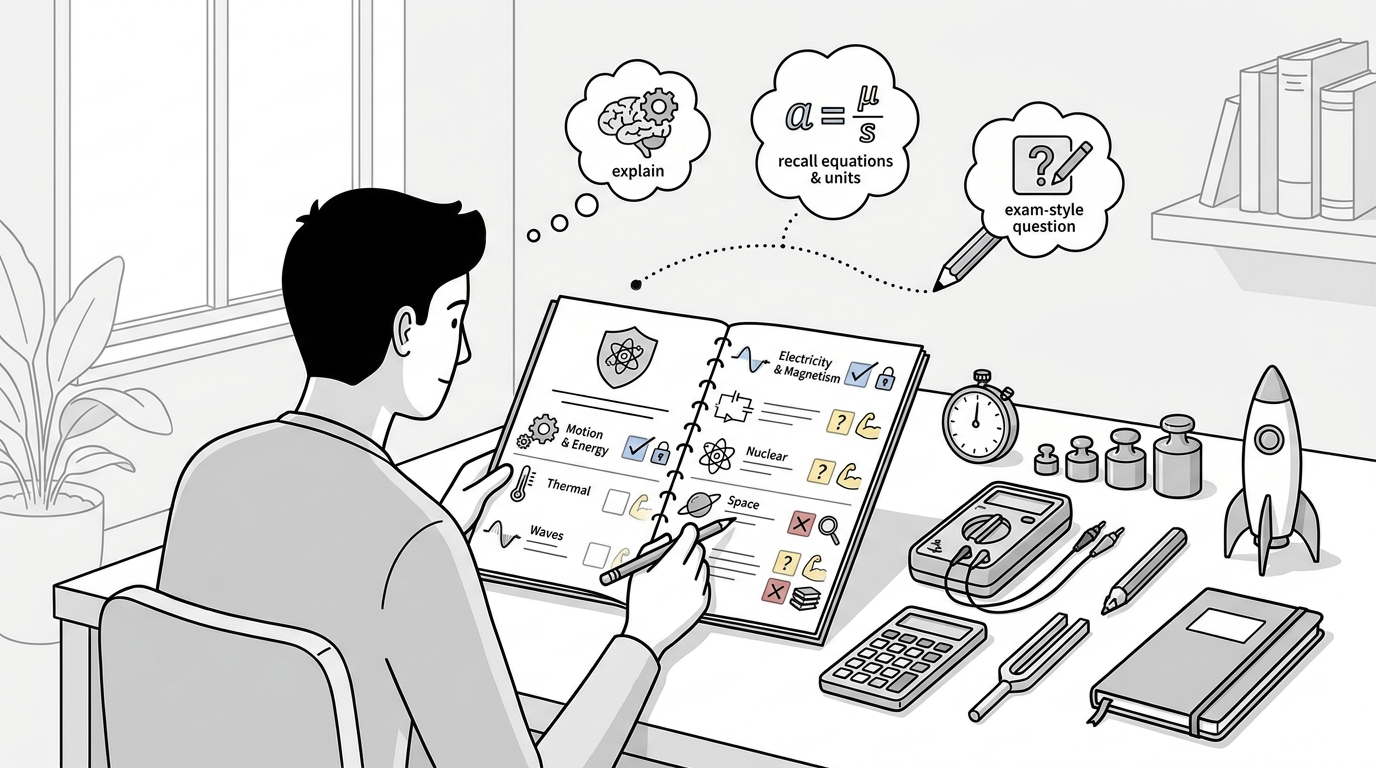
Use the official syllabus as your coverage checklist rather than relying solely on a textbook contents page or an online revision list. Make sure your resources cover the Extended content required for your examination.
For each syllabus statement, ask:
- Can I explain this without looking at my notes?
- Can I recall and use the relevant equations and units?
- Can I answer an exam-style question on it independently?
Classify the result as secure, developing or priority. A topic is not secure just because the explanation looks familiar when you read it.
Organise your checklist into the broad areas in your syllabus, such as motion and energy, thermal physics, waves, electricity and magnetism, nuclear physics, and space physics. Check the precise requirements against your current syllabus rather than assuming every resource has the same coverage.
Diagnose weaknesses with questions
Attempt a mixed selection of questions without notes. Mark them, then identify the cause of each error:
- Missing or inaccurate knowledge
- Wrong choice of equation or principle
- Unit conversion or arithmetic error
- Incomplete explanation
- Misread graph, diagram or instruction
- Difficulty completing the work in time
This diagnosis matters. If you understand a topic but repeatedly mishandle unit conversions, rereading the chapter is unlikely to solve the problem.
Use active recall instead of repeated rereading
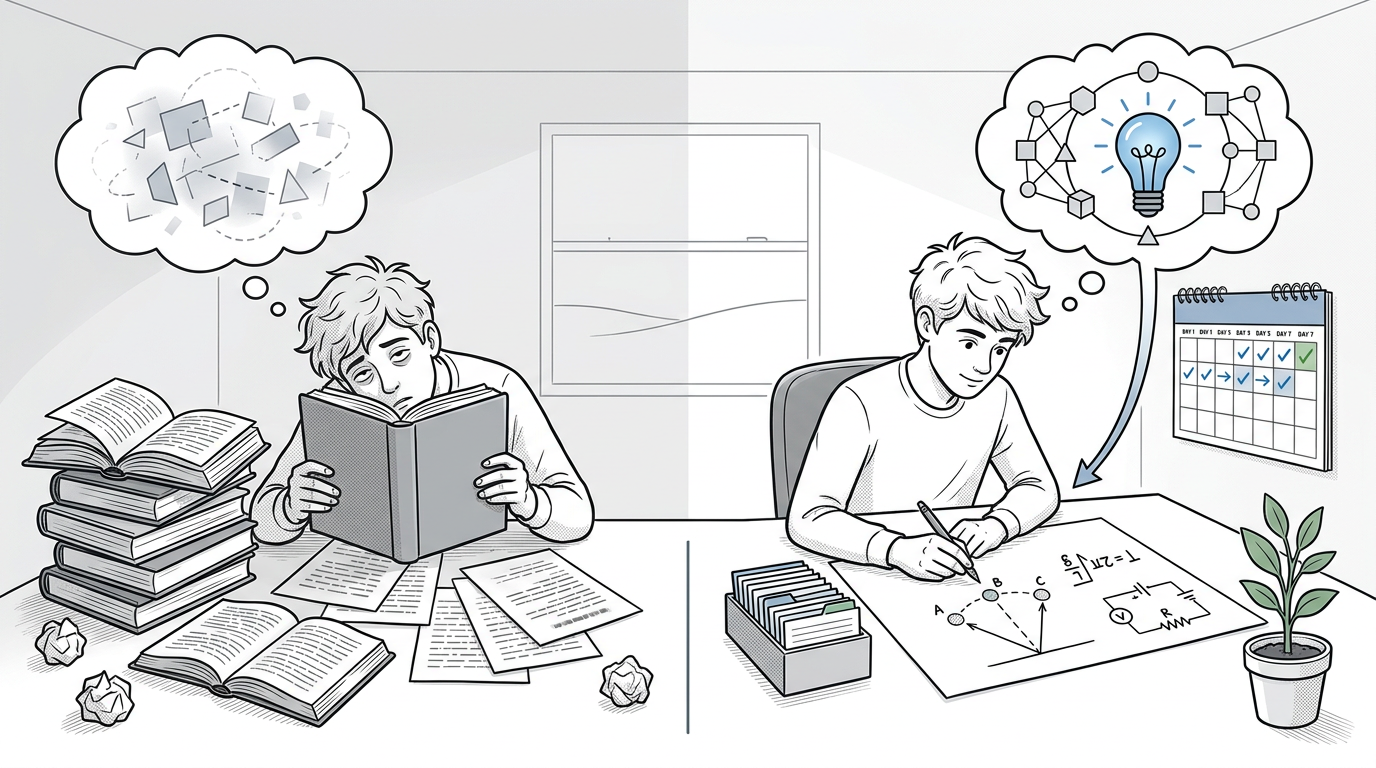
Active recall means retrieving information from memory before checking it. It shows what you can actually produce under exam conditions.
Try a short closed-book task at the start of each session:
- Write the equations associated with one topic and define every symbol.
- Sketch and label a diagram from memory.
- Explain a process aloud in a few sentences.
- Answer several short questions on definitions or relationships.
- Describe how changing one variable affects another, stating what remains constant.
Then check your answers and correct omissions. Reading is useful when you need to understand or repair an idea, but it should lead back to a task you complete independently.
Space your recall over time
Revisit material across several sessions rather than concentrating all practice into one evening. For example, retrieve a topic the next day, again a few days later, and again the following week.
Treat this as a flexible schedule. Topics you keep forgetting need earlier revisits; secure topics still need occasional checks. Flashcards work best for focused prompts, such as a definition or unit, rather than an entire page of notes.
How should you practise physics calculations?
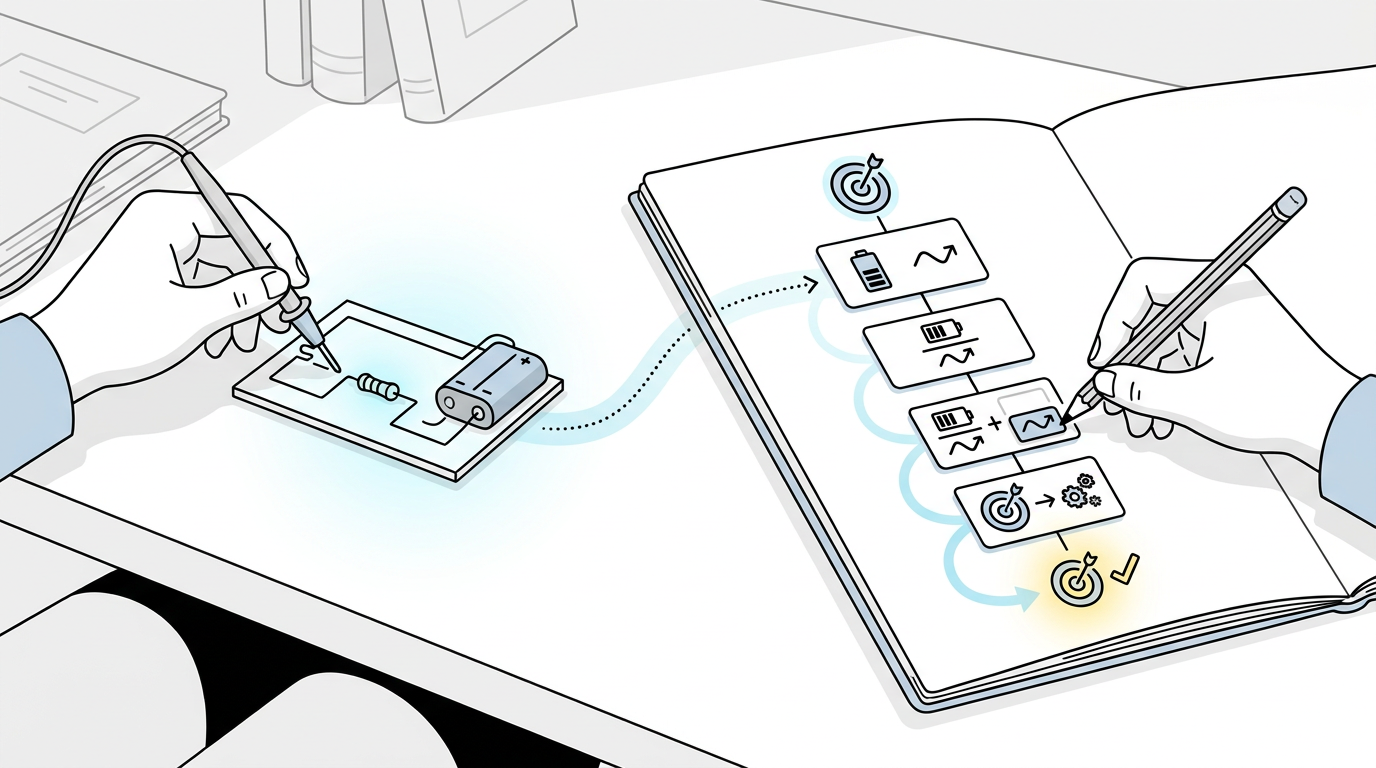
Calculations require more than remembering a formula. You need to identify the relevant quantities, choose a relationship and handle units consistently.
Use this routine:
- Identify the target quantity. What exactly must you calculate?
- List the given information. Include units.
- Choose a suitable equation. Write it before substituting values.
- Convert units where necessary. Make the values compatible with the equation.
- Rearrange and calculate. Show enough working to make your method clear.
- Check the answer. Include the unit and judge whether the result is reasonable.
For example, if a resistor has a potential difference of 6.0 V across it and a current of 0.30 A through it:
R = V / I = 6.0 / 0.30 = 20 Ω
The important habit is the visible chain from equation to substitution to answer. Showing a valid method can help your work receive appropriate credit even when a later arithmetic error occurs, although marking depends on the question.
Practise equation selection as well as substitution
Once straightforward questions feel comfortable, mix calculations from different topics. If every question on a worksheet uses the same equation, you may be practising arithmetic without practising the decision that comes first.
Include questions requiring more than one step. For each step, state what you are finding and why it is needed next.
Keep extra calculator digits during intermediate working and round the final answer appropriately, following any instruction in the question. Check powers of ten, prefixes and squared quantities carefully.
How can you improve written explanations?
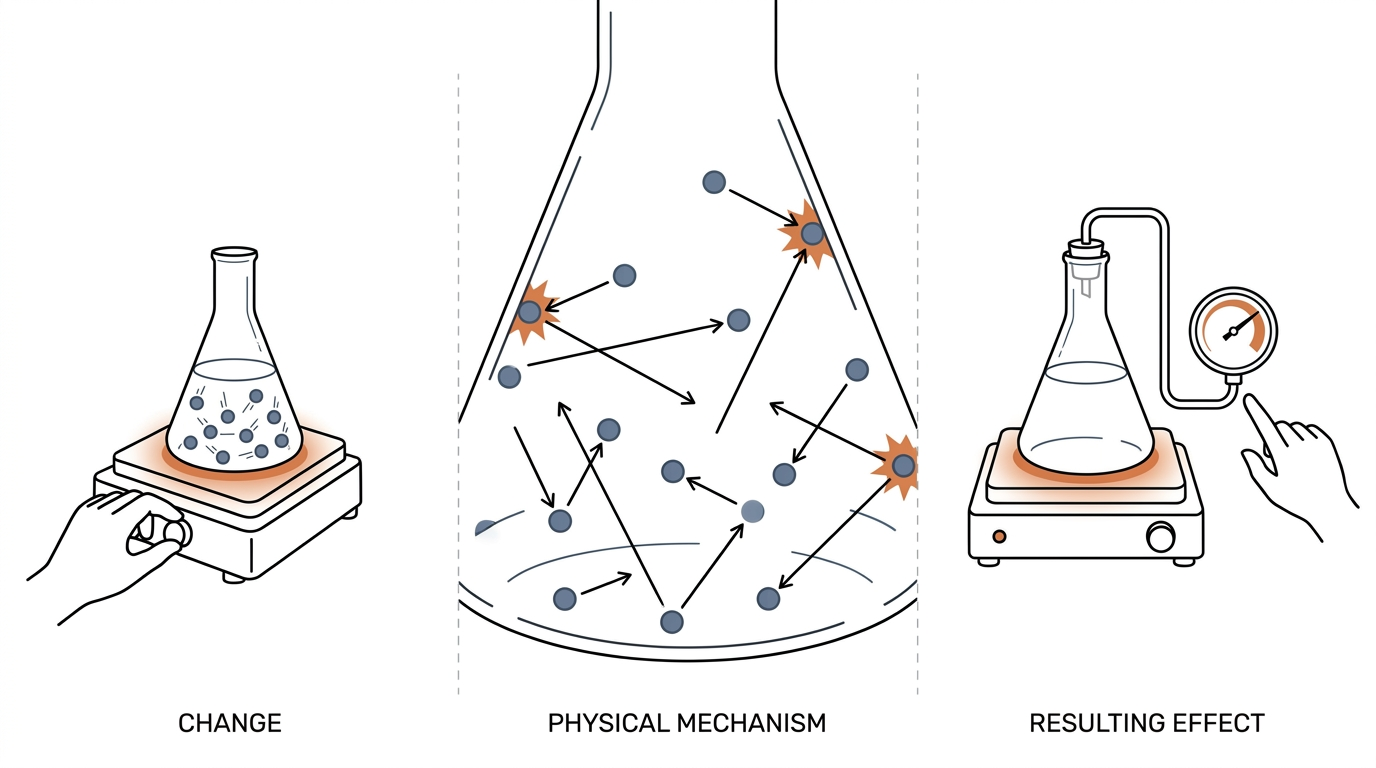
A strong physics explanation connects a cause to an effect through a relevant physical principle. Avoid simply repeating what the question says happens.
A useful structure is:
Change → physical mechanism → resulting effect
For example, to explain why a fixed amount of gas exerts greater pressure when heated at constant volume:
- The particles have greater average kinetic energy and move faster.
- Collisions with the container walls become more frequent, and the average momentum change per collision increases.
- The average force on the walls increases, so the pressure increases.
The fixed-volume condition matters. Good explanations account for the conditions in the question rather than reproducing a memorised paragraph regardless of context.
Match the command word
Practise recognising what the instruction requires:
- State: give the requested fact or relationship directly.
- Describe: set out what happens or identify relevant features.
- Explain: give reasons using physics principles.
- Calculate: work out a numerical result and show the method.
- Compare: refer explicitly to both items, identifying relevant similarities or differences.
Consult Cambridge's current command-word guidance for formal definitions. Use the marks available as a rough guide to the amount of relevant detail, not as a rigid rule that every sentence earns one mark.
Do not neglect graphs and diagrams
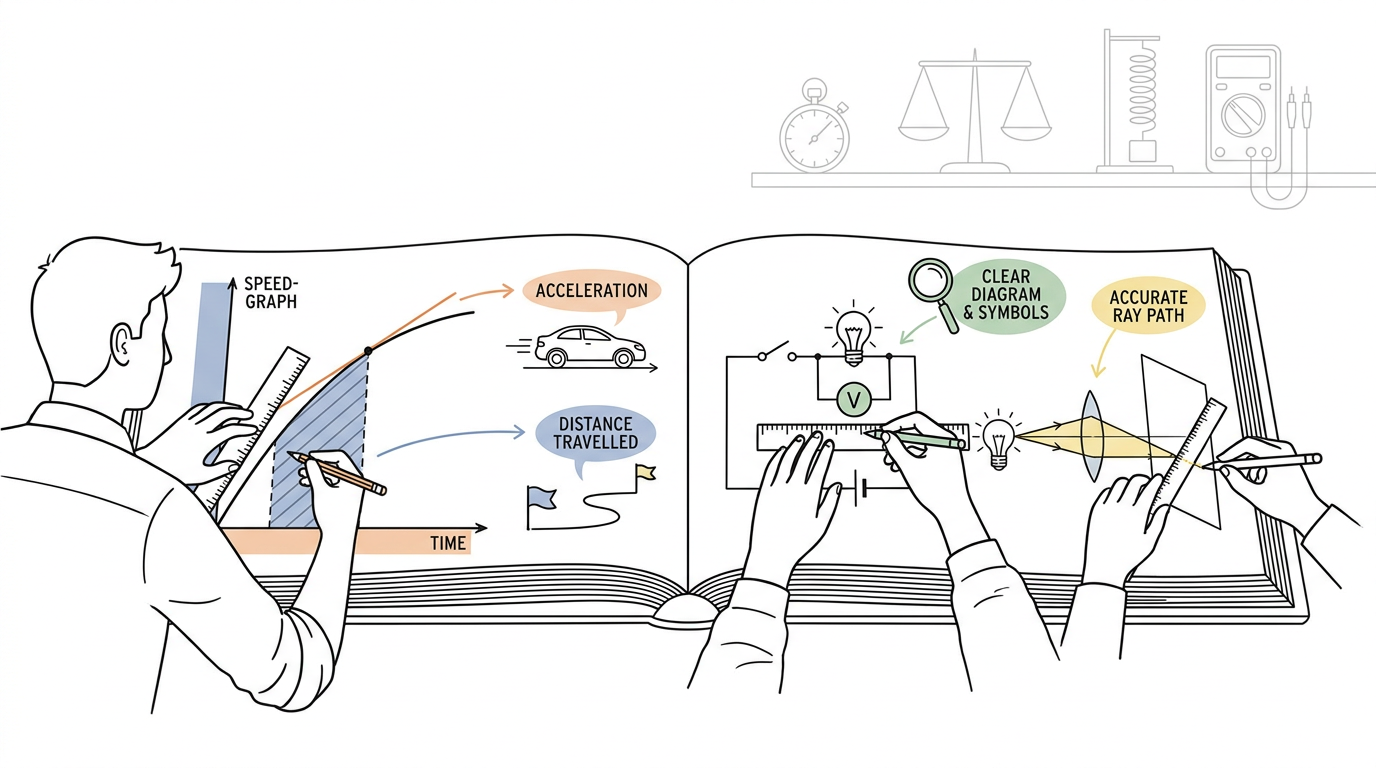
Graph and diagram questions test whether you can translate between different representations of physics.
When revising graphs, practise:
- Reading scales and units accurately
- Describing trends without assuming every relationship is proportional
- Finding gradients using well-separated points on an appropriate line
- Interpreting gradients or areas where the physics requires it
- Linking the graph's shape to what is happening physically
For example, the gradient of a speed–time graph represents acceleration, while the area beneath it represents distance travelled. These meanings come from the quantities on the axes: do not assume that every gradient represents speed.
For diagrams, practise clear labels, correct symbols and unambiguous arrows. Whether drawing a circuit, a ray path or forces acting on an object, make each feature serve a physical purpose.
How should you use past papers and mark schemes?
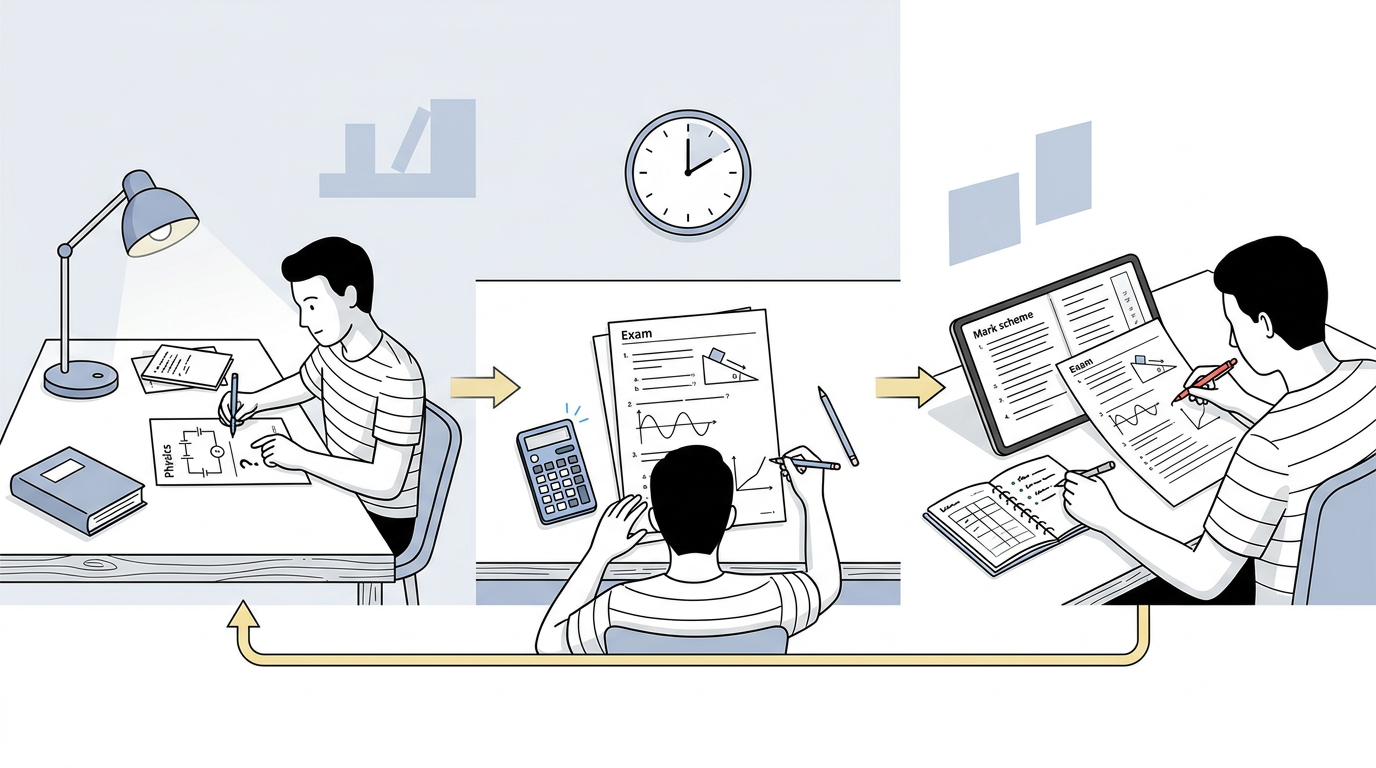
Past papers are most useful as part of a correction cycle, not simply as a way to accumulate completed papers.
1. Begin with targeted questions
After reviewing a weak topic, attempt relevant questions without notes. This tests whether your revision has improved your independent performance.
Use papers and questions that fit your syllabus. Older questions can still be useful, but check their relevance rather than assuming every item remains required.
2. Progress to mixed and timed work
Mixed practice forces you to identify the topic and select a method yourself. As your knowledge becomes more reliable, complete timed sections and then full papers using the duration stated in the relevant official materials.
Practise with the calculator you intend to use, and follow the permitted conditions. Reserve some papers for realistic practice rather than reading all their answers in advance.
3. Mark carefully and repair errors
Compare your work with the official mark scheme. Ask whether your answer contains the necessary physics, not whether it vaguely resembles the example wording. Equally, do not assume only one exact sentence can express a valid idea.
Keep a short error log with four entries:
- Topic or question reference
- What went wrong
- The correct principle or method
- A specific follow-up task
For instance, replace “careless mistake” with “used centimetres instead of metres when calculating work done”. Then complete a few related conversions or calculations and reattempt the original question later without the solution visible.
Build a realistic weekly revision routine
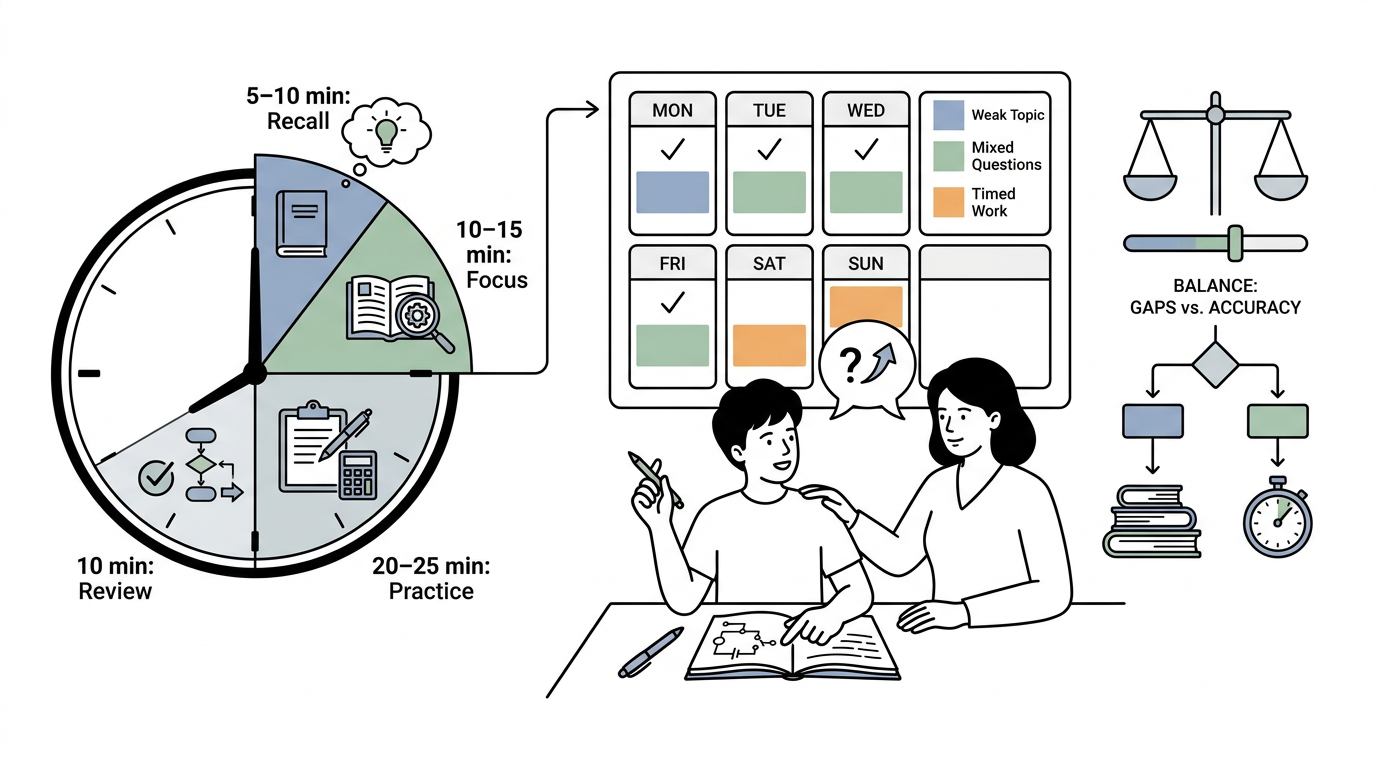
A manageable routine is more useful than an ambitious timetable you cannot sustain. A 45–60 minute session might contain:
- 5–10 minutes: closed-book recall of earlier material
- 10–15 minutes: focused review of one weakness
- 20–25 minutes: independent exam questions
- 10 minutes: marking, corrections and a follow-up plan
Across the week, include weak-topic practice, mixed questions and some timed work. Adapt the balance to your diagnosis: a student with large knowledge gaps needs a different plan from one whose main difficulty is finishing accurately.
Parents can help by protecting study time, asking students to explain an idea aloud and encouraging them to review mistakes. The useful question is “What can you now do independently?” rather than simply “How long did you revise?”
What should you do close to the exam?
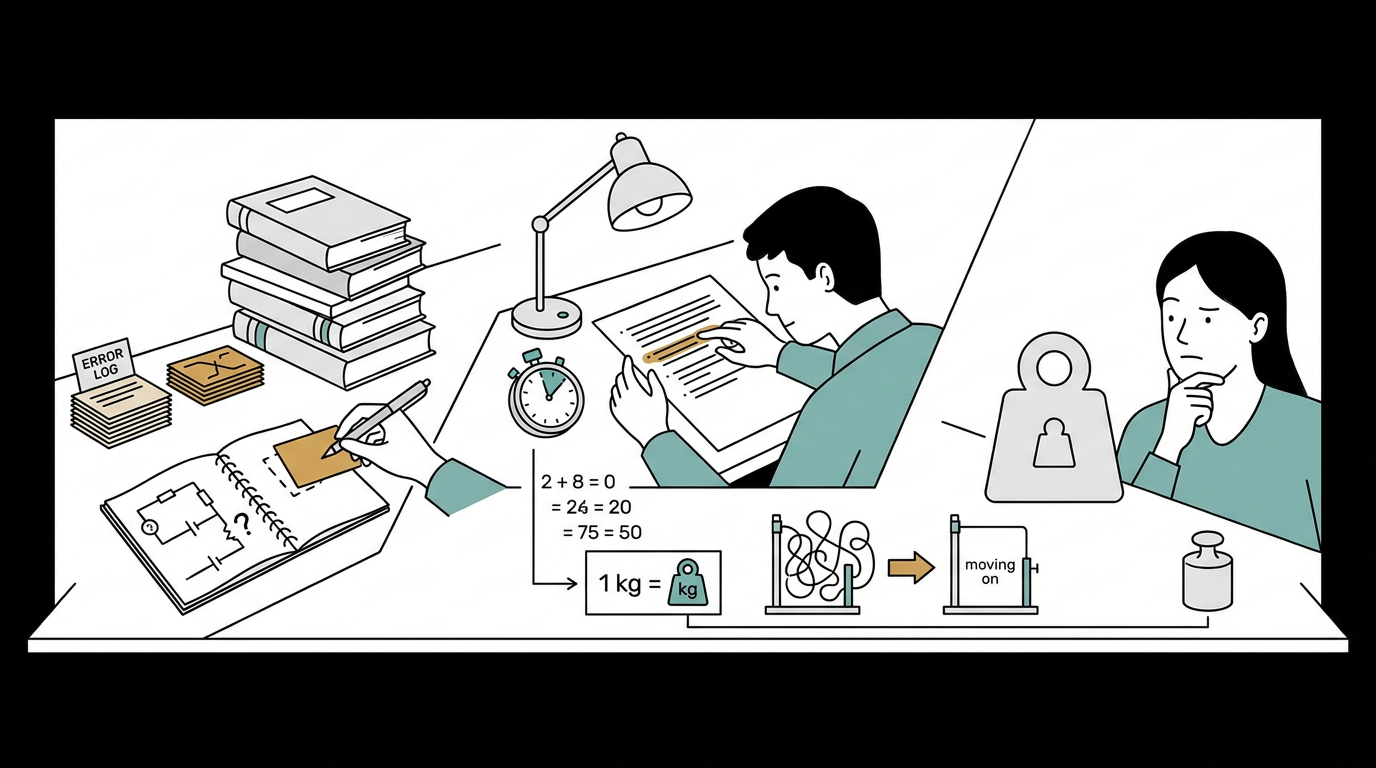
Prioritise recurring mistakes, equation recall, units and explanations you still find difficult. Use your error log to choose short, purposeful tasks instead of repeatedly practising favourite topics.
In timed practice, develop habits you can repeat in the exam:
- Read the whole question and identify key conditions.
- Use the marks and remaining time to judge your pace.
- Show working and include units.
- Move on if stuck, then return if time allows.
- Check answers against the context, especially surprising numerical results.
Avoid replacing sleep with unfocused last-minute reading. The aim is to arrive able to retrieve and apply what you have learned.
Summary
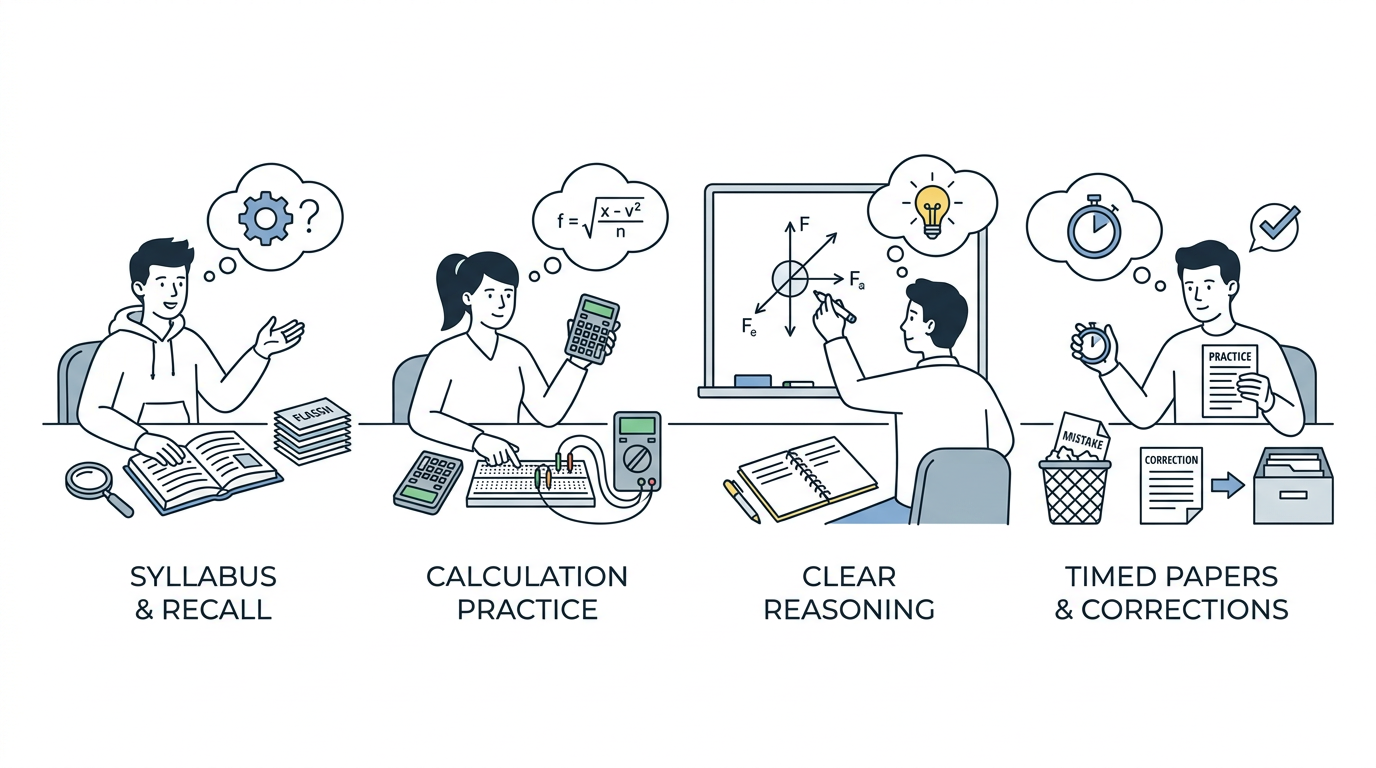
Effective CIE IGCSE Physics Paper 4 revision combines syllabus coverage, active recall, calculation practice and clear written reasoning. Use targeted questions to repair weaknesses, mixed questions to develop equation selection, and timed papers to practise pacing. Most importantly, turn every significant mistake into a specific correction and a later independent reattempt.